
Ground Support Equipment
“It all looked so easy when you did it on paper — where valves never froze, gyros never drifted, and rocket motors did not blow up in your face.” Milton Rosen — Viking rocket program lead

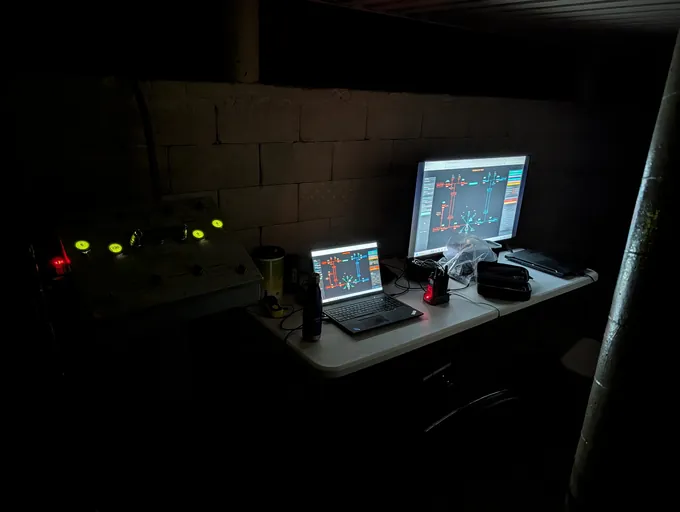
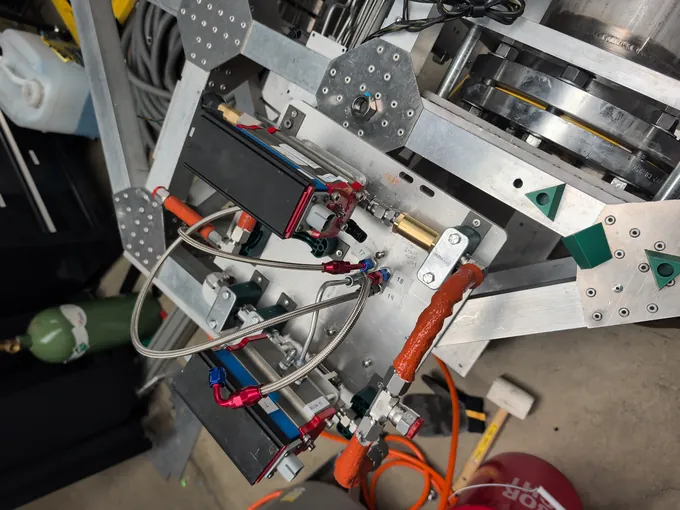
The Ground Support Equipment team builds, operates, and maintains Monolith, our mid-sized engine test stand. Monolith is what lets PARSEC hot-fire bipropellant liquid engines, running both cryogenic and storable fluids. It holds the engine, loads and pressurizes the propellants, and sequences the ignition. Its modular design lets us reconfigure tests quickly and troubleshoot without tearing the stand down. Safety is the first principle of our design methodology, present in every design decision and every operating procedure we write.
Good ground support is invisible: propellant loading procedures, remote operation from a safe distance, relief paths for cryogenic LOX, and checklists that make a hot fire routine instead of an adventure. RUDy earns its data on Monolith today — and ICICLE will qualify here before it ever lifts Icarus.
Team interests
- Fluid system design and plumbing
- Cryogenic handling and safety
- Test operations and procedure writing
- Instrumentation and data acquisition
- RUD-resistant systems
Responsible engineers
- Maxwell BraithwaiteGSE Lead
- Elise Chu
- Ettienne Caban-Klepac
- Sandhya Rajesh
- Emily Snyder
- Tara Zhan
- Jacqueline Zhou
Projects
Operational
Monolith
Our hot-fire test stand for LOX/kerosene engines — propellant loading, sequencing, aborts, and instrumentation.
In development
Icarus GSE
Design, build, and upkeep of every piece of ground support and handling hardware Icarus depends on.
In development
Minilith
A smaller stand dedicated to gaseous oxygen and methane igniter testing.
Planned
Megalith
The largest — and last — stand we’ll ever need: built for higher chamber pressures and roughly three times the propellant volume of Monolith.