
Avionics
“Today, your cell phone has more computer power than all of NASA back in 1969, when it sent two astronauts to the moon.” Michio Kaku — theoretical physicist and futurist

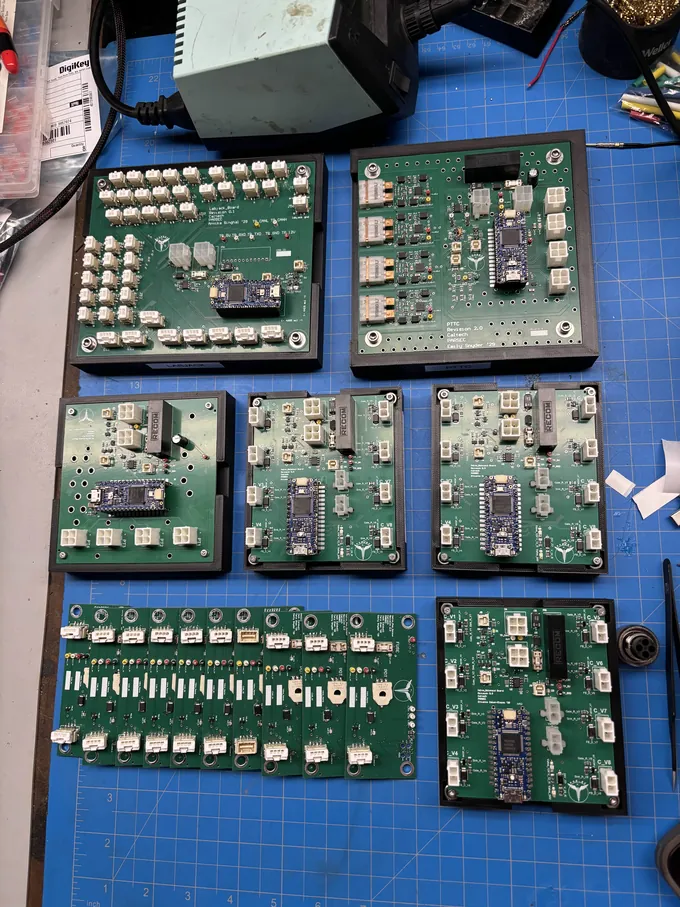
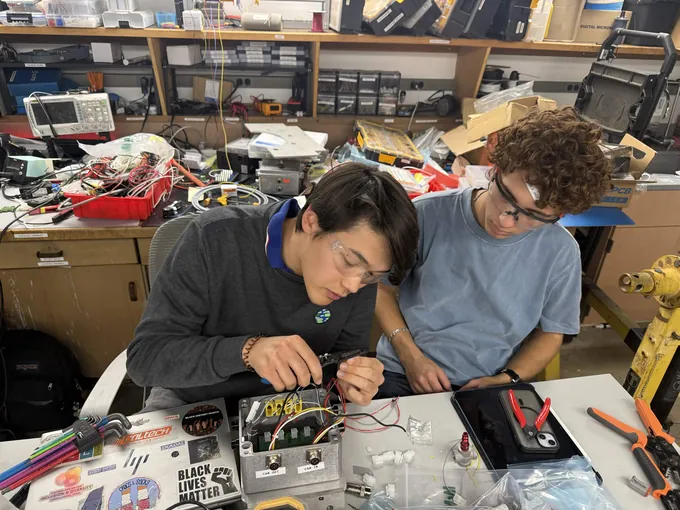
The Avionics team builds custom PCBs for almost everything PARSEC needs, including interfaces between sensors, actuators, and control. After extensively conducting system level tradeoffs with formal design reviews, we design PCBs using Altium, export files for manufacturing, solder our own components, crimp our own wires, and bring the system to life.
Our hardware lives in many places. On Icarus and Daedalus, it reads the sensors, relays telemetry, and commands the engine, TVC, and RCS. On Monolith, it allows us to conduct tests from a safe distance, while recording every channel of data the propulsion team needs.
Designing for the lab bench is not enough. Given that we test and launch at the Friends of Amateur Rocketry in the Mojave Desert, major concerns like dust, wind, and heat require us to carefully contain all electronics in sealed enclosures while ensuring nothing overheats. On Icarus, vibration becomes an even greater issue and every single component and connector must be chosen with that in mind.
Team interests
- Embedded systems and firmware
- PCB design, layout, and hardware bring-up
- Sensing, instrumentation, and data acquisition
- Real-time communication networks (CAN)
- Harness design and electronics packaging
Responsible engineers
- Daniel WarehamAvionics Lead
- Ron Freeman
- Zilan Xiong
- Ettienne Caban-Klepac
- Ella Guo
- Parnika Singh
- Anvika Singhal
- Emily Snyder
- William Wrolstad
- Tara Zhan
Projects
In development
Icarus flight avionics
The flight computer, sensor suite, and power systems that fly the lander.
Operational
Monolith control & DAQ
Remote sequencing, abort logic, and data acquisition for hot-fire operations.